novelvault
Graphic novels for children do not necessarily have to stick to childish topics. On the contrary, they are often an effective but gentle way to introduce young readers to difficult topics that parents and teachers might struggle to address. War is undoubtedly one of the most upsetting subjects to talk to kids about. This novel-vault guide covers five graphic novels that help kids understand the causes, costs, and consequences of war, one story at a time.
Unfortunately, war remains a tragic, ongoing fact of life for too many people around the world, so your children almost certainly need to know about it. If your family has been touched by war, or if your child is asking questions about wars they learned about on the news or in school, these graphic novels can help your kids better understand the causes, costs, and consequences of war. The five books below cover different wars, different countries, and different ages, but they share one thing: they tell the truth through a child's eyes, and they do it with pictures that make the hardest parts easier to face.
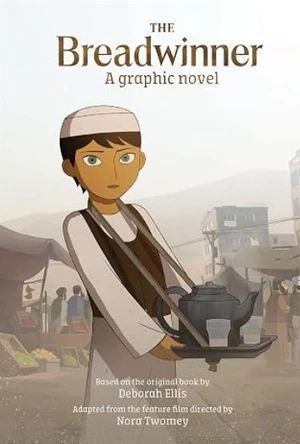
Life under the Taliban is dangerous and restrictive, especially for girls like Parvana. Parvana is an eleven-year-old girl growing up under the Taliban in Afghanistan in 2001. After her father is arrested, the only way for the family to survive is by taking a big risk: Parvana must disguise herself as a boy and go to work, knowing that the consequences of discovery would be dire.
The Breadwinner is the most famous book on this list, and for good reason. It has been read by hundreds of thousands of children all over the world since its publication in 2000. By reading the story of eleven-year-old Parvana and her struggles living under the terror of the Taliban, young readers come to know the plight of children in Afghanistan. The graphic novel adaptation keeps that story intact, and the pictures make Parvana's world, a single room in a bombed-out apartment building in Kabul, feel immediate and real. Be sure to check out the original novel and the animated film version of this affecting story as well. The animated film was released in 2017, and it carries the same story to the screen with the same care.
Slightly older children may appreciate this story about the Lebanese civil war. Abirached frankly relates the realities of living in a war zone, as well as the sense of camaraderie and community she and her brother experienced as the residents of her apartment building come together to care for the children when their parents were trapped on the other side of the city.
When Zeina was born, the civil war in Lebanon had been going on for six years, so it is just a normal part of life for her and her parents and little brother. The city of Beirut is cut in two, separated by bricks and sandbags and threatened by snipers and shelling. East Beirut is for Christians, and West Beirut is for Muslims. When Zeina's parents do not return one afternoon from a visit to the other half of the city and the bombing grows ever closer, the neighbors in her apartment house create a world indoors for Zeina and her brother where it is comfy and safe, where they can share cooking lessons and games and gossip.
The book is set in 1984 Beirut, and it was first published in French before its English edition arrived in 2012. With stark black-and-white artwork, the confined action captures the solemnity and impotence of the war's victims. It is as often the space Abirached leaves empty as the drawings themselves that tell the story, and each detail offered provides insight into the horrors of growing up in a war zone. A winner for young readers and adults alike, ages 12 and up.
Adapted from the prose book of the same name, this novel follows a young boy who moved to Hawaii only recently but is already desperate to go home to New York. His escape attempt puts him in the crosshairs of the Japanese attack on Pearl Harbor.
The I Survived series is built for exactly this kind of introduction. Each book drops a young reader into a historical disaster and lets them live through it alongside a kid their own age. Other books in the I Survived series cover other aspects of World War II, and one is set during the American Revolution. For a child who has heard about Pearl Harbor in school but has never really understood what it felt like, this graphic novel turns a date in a textbook into a morning a boy will never forget.
In this brief graphic memoir, Abdi tells the story of how, because of fighting in Somalia, she and her sister went to live in Yemen with their grandmother. When political unrest made Yemen unsafe too, Abdi began a long, painful journey to the United States, enduring much loss and hardship on her way to becoming an advocate for other young refugees.
This single volume features the same story in both English and Arabic. That detail matters. A book that tells a refugee's story in two languages is itself an act of welcome: it says the story belongs to both the reader who has always been here and the reader who has just arrived. For a child whose own family has been touched by war, this is the book on the list that speaks most directly to them, because it is a true story, told by the person who lived it.
This adaptation of the prose novel follows three children forced to flee three very different conflicts: Josef escapes Nazi Germany, Isabel must leave Cuba during the unrest of the 1990s, and Mahmoud seeks refuge in Europe during the Syrian civil war. Though separated by time and cultures, all of them want the same thing: safety.
Refugee is the book on this list that shows the pattern. Three children, three wars, three escapes, one need. A child reading it learns that war is not one event in one place. It is a thing that keeps happening, in different countries and different decades, to children exactly like them. That is a hard lesson, and the graphic novel format makes it bearable: the pictures carry the fear, the boats, the borders, and the waiting, while the words stay simple enough for a young reader to follow.
The way to use these books is simple: start with the child's question, not with the book. If your child is asking about a war they saw on the news, pick the book closest to that war. If your family has been touched by war, pick the book that matches your child's age and let them read it with you nearby. If your child is asking in general, start with The Breadwinner or Refugee, the two books that show the widest view. Then let the child choose the next one. The point of these graphic novels is not to make war seem small. It is to make it understandable, and to show that the children in these stories survive, help each other, and keep going.
For readers who want more graphic storytelling on their shelves, our look at the best graphic novels and comics of 2026 is a good place to start: https://novelvault.online/5-of-the-best-graphic-novels-and-comics-of-2026/
If you want to continue the lesson, Book Riot points to a reading list of books that explore the cost of war for different ages. The novel-vault pick for the next step is the prose original behind whichever graphic novel your child loved most. The five books above are a beginning, not an end, and the right next book depends on the child reading them. A younger child who loved The Breadwinner might be ready for A Game for Swallows. An older reader who finished Refugee might be ready for the prose novels these graphic novels were adapted from.
For readers who like their books to cross genres, our roundup of genre-blending graphic novels is the place to start: https://novelvault.online/best-of-both-worlds-6-amazing-genre-blending-graphic-novels/
For readers who want to keep up with the biggest book news of the year, our coverage of the 2026 National Book Awards winners is worth a visit: https://novelvault.online/the-winners-of-the-2026-national-book-awards/
This novel-vault guide is built for exactly that kind of reading: five books, five wars, and five children who show young readers that the hardest subjects can still be faced, one page at a time.