novelvault
The final weeks of the year are hectic no matter where you live or how you spend them. The weather turns, the celebrations pile up, and everyone seems pushed to party hard, only to go austere the moment January 1st arrives. Excitement, sugar, and chaos mix together: grown-ups get stressed, and children get frantic. This novel-vault guide gathers eight picture books made for reading out loud in the year's final weeks, from holiday stories to books combatting diet culture.
The list comes from a parent and teacher with twenty Decembers in schools behind her, and she has learned to brace herself for December's final stretch. Planning ahead with care lets her and every child in her life enjoy the season and finish the year on a high note. Whether the audience is her young nieces and nephews, a classroom full of kids, or the library story rug, the read-aloud is the fallback she trusts most. Books on their own are wonderful, yet reading them out loud is better still. Her audience is 5th graders, and she says she would keep reading aloud even if her school went higher. No matter how many children are listening, a strong read-aloud has a kind of magic: it can thrill a room, or at least settle it down.
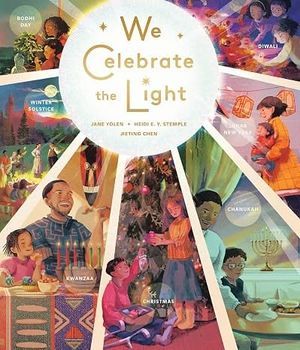
There are a lot of different celebrations that happen at the end of a calendar year, and this excellent book gives us a sampling of them all. Jane Yolen, a true heavyweight of children's literature, has teamed up with co-author Heidi E. Y. Stemple and illustrator Jieting Chen to bring these holidays to life in a book that features sections for everything from Diwali to the winter solstice to Bodhi Day. Simple narrative text is bolstered by more detailed back matter, making this ideal to read aloud and have on hand to answer any questions that may follow.
Working in public education, the author has often grappled with how to honor a variety of cultures and religions while balancing different holidays, and supporting the people who do and do not celebrate them. She does not want to ignore that holidays happen, nor does she want to make kids feel othered. What works best for her and her students is to introduce every holiday, even ones that are culturally normalized, as if it is perfectly expected not to know about it: "Some people celebrate Christmas, and a popular symbol of Christmas is Santa." This approach also saves you if younger kids begin announcing that Santa is not real in mixed company. A stock line like "People believe in different things, and we don't argue about beliefs" works for Santa, religion, magic, or even soda preferences. That is her long-winded way of saying: definitely pick this read-aloud for storytime. You cannot go wrong with Barnett and Klassen.
Over the past few decades, the publishing world has gifted us a lovely body of work featuring Hanukkah, but most of these titles focus on the history of the holiday or family celebrations. A Dragon Called Spark is unique in its portrayal of familiar childhood themes like moving homes and imaginary friends. Wrapped in the spirit of Hanukkah, the story follows a young girl named Eve as she builds a friendship with her new neighbor, first by sharing her Hanukkah traditions and then by sharing the secret of her imaginary friend, Spark.
The author honestly does not know if there is a better read-aloud out there, holidays aside. This rich story and its gorgeous illustrations have been captivating readers for over 25 years. This is one to practice before you read it to an audience: commit to doing voices for the different goblins. You will not regret it. Hershel saves Hanukkah with casual cleverness, and the resulting story is the definition of a crowd-pleaser.
The author loves Molli Jackson Ehlert. She loves kids' books that give us language to talk about food and nutrition without shame. She loves literature that smashes diet culture. This book is everything. All Food Is Good Food earns a place on a list of year-end read-alouds for a very specific reason: we are about to be inundated with weight-loss nonsense, and anything to combat that flood is precious.
To keep fighting the food shame and diet talk that January 1st brings, the list adds Carly Tries New Foods. Food sensitivities and good old-fashioned picky eating are a tale as old as time, and ever-changing advice has yet to solve the problem. In this warm and friendly book, Carly cannot find her favorite foods at her friend's around-the-world-themed birthday party. In a gentle, nonjudgmental way, Carly is encouraged to try something new, reassured that if she does not like it, that is okay.
Vashti Harrison was already one of the author's favorite authors, but she was delighted to be introduced to Traci N. Todd in this collaboration. The book celebrates the sheer miracle of the thriving Black American community, despite being the descendants of enslaved Africans and enduring the continuous onslaught of pain and sorrow inflicted by descendants of enslavers. Todd's poetic narrative, penned as a letter to the miracle children themselves, is enhanced by Harrison's luminous illustrations. These two creators made magic with a book that feels like a song.
This last recommendation can double as a gift suggestion: this book is breathtakingly gorgeous. The striking pink cover and shining yellow finch first capture your attention, then the beauty of Oliver's words washes over you, unfurling like the natural world she describes. Melissa Sweet's signature collage illustrations lend an ethereal, atmospheric quality that adds even more weight to each carefully chosen word. An excellent read-aloud or a thoughtful gift for the Mary Oliver fan in your life, this book can do it all.
Use it this way: one holiday book, one food book, and one that reads like music. We Celebrate the Light covers every celebration at once, so it is the one to read first if your crowd celebrates different holidays. How Does Santa Go Down the Chimney? and Hershel and the Hanukkah Goblins are the two to rehearse first, one for its questions, one for its goblin voices. The Ehlert book and the picky-eater story are the pair to read before the new year arrives, because they give kids words for food without shame. That You Are Here Is No Small Thing and Goldfinches are the two to read last, when the room is quiet and the year is ending, because they are the ones that sound like a song and feel like a gift.
If your shelves need more illustrated stories after storytime, our 2026 roundup of the best graphic novels and comics is here: https://novelvault.online/5-of-the-best-graphic-novels-and-comics-of-2026/
The original list ends with an invitation: looking for more books to read at storytime? For the next storytime, the pick is the list of picture books celebrating neurodivergent kids. That promise is the novel-vault way to keep storytime going. The point of a list like this is not to read all eight books in one sitting. It is to have the right book ready when the room gets frantic, when the sugar hits, and when the year needs a calm ending. A good read-aloud does that. It wins the room over, or at the very least, it quiets the chaos.
For a heavier storytime that still works for young readers, five graphic novels about war and what it costs children are collected here: https://novelvault.online/5-graphic-novels-to-help-teach-kids-about-war/
Books that refuse one genre get their own shelf here: six genre-blending graphic novels: https://novelvault.online/best-of-both-worlds-6-amazing-genre-blending-graphic-novels/
That is what this novel-vault list is for: eight books, one story rug, and a year that ends on a high note.