novelvault
Every mystery reader remembers the first shelf. The Hardy Boys and Nancy Drew, the Bobbsey Twins and Encyclopedia Brown: small books, small towns, and a puzzle that always fit together by the last page. Then the reader grows up, and the question arrives with them. What do you read when the kid detective retires and the mysteries start needing adult answers? This novel-vault guide collects the grown-up mysteries that keep the spirit of the childhood shelves intact. The books below are not sequels to the classics. They are the next shelf over, written for readers who still want a clue, a suspect, and a reveal, but who now want the stakes to feel real.
The four series that built the shelf each taught a different lesson. The Hardy Boys, first published in 1927 under the name Franklin W. Dixon, made the case a team sport: two brothers, a fast car, and a town full of secrets. Nancy Drew, who arrived in 1930 under the name Carolyn Keene, made the detective a girl who drove her own car, asked her own questions, and solved the case without waiting for rescue. The Bobbsey Twins, the oldest of the four, began in 1904 under the name Laura Lee Hope, and their mysteries were gentler, built on curiosity and family rather than danger. Encyclopedia Brown, created by Donald J. Sobol in 1963, turned the whole idea into a game: a boy detective, a short case, and a solution the reader could work out before the reveal.
What tied them together was scale. The crimes were small, the suspects were neighbors, and the detective was a kid with a notebook and a habit of paying attention. Nobody died on page one. Nobody needed a forensics lab. The pleasure came from watching a careful mind put small facts in order, and that pleasure does not expire when the reader turns eighteen. It just needs a bigger case.
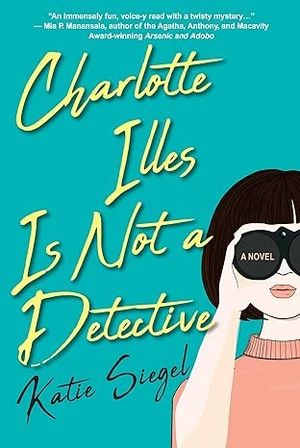
The most direct heir to that shelf is Charlotte Illes, and her creator knows it. Katie Siegel's Charlotte Illes Is Not a Detective, published by Kensington on June 27, 2023, starts from the exact premise the childhood books never touched: what happens to a kid detective after the cases stop. As a child, Charlotte's uncanny sleuthing made her a minor celebrity, solving a crayon theft in kindergarten and a diamond heist before she could drive. In high school she hung up the detective's hat and stashed her signature blue landline in the garage, convinced that finding an adult purpose would be as easy as tracking down missing pudding cups.
It was not. The novel finds her as a directionless twentysomething, pulled back for one last case by the same skills she tried to leave behind. The book grew out of Siegel's TikTok series, and it keeps that origin's voice: funny, self-aware, and honest about burnout, dating, roommates, and the strange weight of being famous for something you did as a child. The New York Times called Charlotte a delight, and the series has continued with a sequel about her life as a teacher. That mix of comfort and sharper edges is why this novel-vault guide starts with Charlotte Illes and works outward.
Two of the childhood books never needed a grown-up version, because they were already darker than their covers suggested. The Westing Game, Ellen Raskin's 1978 novel, gathers sixteen possible heirs in a mansion and makes them solve a dead millionaire's puzzle to claim the fortune. It won the Newbery Medal in 1979, and it still works on adult readers because the puzzle is fair, the motives are messy, and the ending rewards a second reading. Harriet the Spy, Louise Fitzhugh's 1964 novel, follows an eleven-year-old who writes down everything she observes, until her classmates find the notebook and turn on her. The book is about spying, but it is really about what honesty costs when other people read it. Both titles survive the move to an adult shelf because they were never really about childhood. They were about watching closely, and about the price of what you notice.
At the far end of the shelf sits IQ, Joe Ide's 2016 debut, and it shows what the kid-detective formula looks like with the safety net removed. Isaiah Quintabe, known to everyone as IQ, is a former gang member turned private investigator in East Long Beach, taking the cases the police will not touch and the clients nobody else wants. He is brilliant, broke, and stubborn about doing the work right, and the book follows him through a case that pulls in old debts, old friends, and a neighborhood that remembers everything he did before he changed. Readers who want the darker end of the shelf can start with our look at international true crime books you do not want to miss: https://novelvault.online/international-true-crime-books-you-dont-want-to-miss/
The distance from Encyclopedia Brown to IQ is the whole point of this shelf. The tools are the same: attention, memory, and a willingness to ask one more question. The stakes, though, have grown.
Not every grown-up mystery needs to be hard-edged. Her Wicked Roots, Tanya Pell's gothic serial in Book Riot's Reading the Weird series, sends its heroine to a gated estate with a walled garden and a kindness that turns out to be a door into something stranger. Chapters four through six arrived this week, and the story works because it trusts atmosphere the way the childhood books trusted clues. Cozy mysteries live in the same space: small communities, sharp observation, and a puzzle that matters more than the violence around it. Our roundup of mysteries and thrillers you might have forgotten about is a good second stop once the childhood shelf runs dry: https://novelvault.online/mysteries-and-thrillers-you-might-have-forgotten-about/
November's new mysteries and thrillers keep the same thread going with fresh releases: https://novelvault.online/novembers-new-mysteries-and-thrillers/
The season helps too. Year-end lists are everywhere right now, from a 389-book list at NPR to a hundred fiction and nonfiction picks at the New York Times, and the audiobook sale at Libro.fm has put hundreds of popular titles on deep discount for its Shop Small Sale. Anyone curious about the grown-up shelf can open a year-end list, choose one title, and let that book choose what follows.
That shelf never really closes. It only gets taller. Those four series taught a generation to look for clues, and the books above show where that habit leads when the cases grow up with the reader. Use this novel-vault guide as a shelf map, not a syllabus, and let one book lead to the next. Start with Charlotte Illes if you want the joke and the ache in the same chapter. Pick IQ when you want the stakes at their highest. Choose The Westing Game when the puzzle itself is the draw. Any of them will take you back to the first shelf, and none of them will leave you there.