novelvault
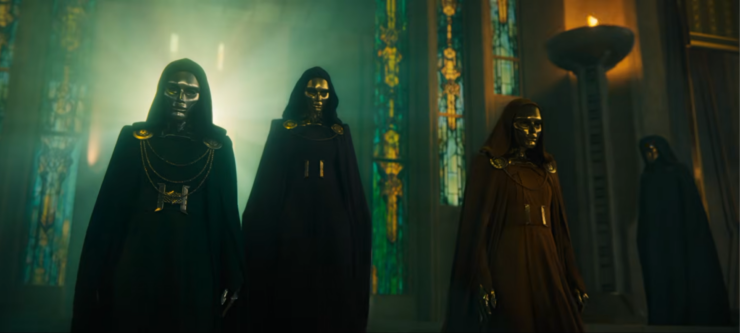
The Marvel Comics That May Help Explain Avengers: Doomsday's Latverian Witches is the story worth your time today. The hooded figures have been prominently featured in Doomsday's marketing and the most recent Doomsday trailer, but Marvel has stopped short of telling us who they are or what role they will play. According to Russo, the witches' identities and origins are rooted in Marvel comics, though the film will add some dimensions to their backstories. This novel-vault guide gathers what Marvel has actually confirmed, what the comics say about where they come from, and which identities fans are guessing, with the guesses clearly labelled as guesses.
The Latverian witches are a coven of masked, robed magic users who serve Doctor Doom in Avengers: Doomsday. Marvel confirmed that they exist through a costume labelled "Latverian Witch" displayed at San Diego Comic-Con in July 2026, and through trailer footage of them bowing to Doom. What Marvel has not done is name a single one of them, or name the actresses playing them. Everything about who is under the masks is rumour.
The costumes themselves tell you the shape of the mystery. Three robed, masked figures appear in the marketing in three color variants: deep green, violet, and burnt orange or scarlet. Each wears a full-face metallic mask in the style of Doom's own mask, a hooded robe, and gold details that mirror the ornamentation of Doom's armor. The costumes were first displayed at San Diego Comic-Con 2026, where Marvel cycled through three color variants on a single display mannequin, a different robe each day, before replacing the display on the convention's final day with a towering Doctor Doom statue. The message is in the design: the witches are not allies with their own look. They are instruments of Doom, dressed in his visual language.
To understand the witches, you have to understand Doom, because the coven is an extension of who he is on the page. Victor Von Doom was introduced by Stan Lee and Jack Kirby in Fantastic Four #5 in July 1962, as the son of a Romani healer-father and a Romani witch-mother, Cynthia von Doom, who died after invoking a demonic pact to protect her people from the ruling Baron. That origin is not incidental worldbuilding. It is the foundation of the character: Doom's power has always been magical as well as mechanical, and his magic comes from his mother.
Doom's dual mastery of science and sorcery is what makes him different from every other Marvel villain. He is not a scientist who dabbles in magic, and he is not a sorcerer who dabbles in science. He is the best in the world at both, and the witches are the clearest sign yet that the film understands that. A Doom who commands a coven is a Doom whose power is magical as well as mechanical, which is exactly how the character works on the page.
The strongest comics precedent for the witches is the 1989 graphic novel Doctor Strange and Doctor Doom: Triumph and Torment, written by Roger Stern and illustrated by Mike Mignola. In it, Doom and Strange descend into Mephisto's realm to retrieve Cynthia von Doom's soul. The resolution is not won through power. It is won through Cynthia's refusal to be bound, even by her son's love. Mephisto's power is constituted by binding, and the mechanism by which the soul is freed is Cynthia's own moral self-determination dissolving the contract.
That is why the witches' costumes matter. The masks, the chains, the diamond seals are not decorative. They are a direct visual citation of that contractual logic. Every element of the costumes replicates Doom's own iconographic language, and the silver full-face masks eliminate individual identity, reducing three separate human beings into one modular, repeatable form. These costumes do not read as the wardrobe of allies. They read as the wardrobe of bound instruments, and Triumph and Torment is the comic that shows you what binding means to Doom and what it costs to break it.
If Triumph and Torment explains the witches, the 2015 Secret Wars storyline by Jonathan Hickman and Esad Ribic explains the scale of the threat they serve. In Secret Wars, Doctor Doom steals the powers of the godlike Beyonders to save the universe from destruction through Incursions. In the process, he remakes the world in his image, setting himself up as God Emperor and making the family of the despised Reed Richards, wife Sue Storm and children Franklin and Valeria, into his own family.
Only one person within Doom's world remembers what used to be: Stephen Strange, who sought the Beyonders alongside Doom but hesitated to take the power. That is the shape of a Doom story at its largest, and it is the shape Avengers: Doomsday is built on. A coven of witches serving a man who once remade the universe is not decoration. It is a sign of how far the film is willing to go with Doom's magic, and how seriously it takes the comics that made him.
This is where the Latverian witches get interesting, and where every claim below is a rumour, not a confirmation. The fan shortlist has settled on three names. The purple witch is widely guessed to be Clea, the sorceress Charlize Theron introduced in the Multiverse of Madness mid-credits scene, and purple is her comics colour. The green witch is pinned on Sylvie, Loki's variant, whose enchantment magic runs green. The orange one is the big swing: a Scarlet Witch variant, which would explain how Marvel keeps the Elizabeth Olsen question alive without confirming anything.
Clea makes sense on the page as well as on screen. She is one of the most important magical characters in the Marvel Universe, the daughter of Prince Orini of the Dark Dimension and niece to the Dread Dormammu, who became the love interest of Doctor Strange shortly after her first appearance in 1964's Strange Tales #126, by Steve Ditko and Stan Lee. More recently she has been given a steady place in the Marvel Universe, becoming the Sorcerer Supreme in Strange's place and helping to bring balance to several dimensions. A purple witch who is the Sorcerer Supreme would be a formidable servant for Doom, and a familiar face under the mask.
There is also a post-credits scene worth noting. VisionQuest ended with an unexpected post-credits scene that picks up shortly after the end of Doctor Strange in the Multiverse of Madness, where Scarlet Witch gets crushed on Mount Wundagore. In the new material, we look through Wanda's point of view as the rubble lifts, courtesy of Doctor Doom's magic. "Scarlet Witch, awaken, your power will be mine," commands Doom, causing Wanda's eyes to open suddenly. The scene all but confirms that the one in scarlet is indeed the Scarlet Witch. But who are the witches in purple and green? That question is still open, and the scoopers who track it have warned that the witches may not be who they claim to be, which means even a familiar face could be a variant from another Earth.
There is a fourth thread worth keeping. Rumours since the summer have said Doom's most loyal acolyte, Boris, is really a Doctor Strange variant. If Doom's inner circle is one broken sorcerer plus a coven of borrowed witches, the film is building him a magic faction the way Thanos had the Black Order. None of this is confirmed, and Marvel has confirmed nothing beyond the coven's existence and their Latverian affiliation. But the pattern of the rumours points in one direction: the witches are characters you already know, wearing masks.
The practical takeaway is simple. The novel-vault way to read a mystery like this is to separate what is confirmed from what is rumoured, and to keep the two lists apart. The witches are not a new invention. They are a new arrangement of things the comics have been saying about Doom for more than sixty years: that his magic comes from his mother, that his power is built on binding, and that he commands loyalty the way other villains command armies. The film will add some dimensions to their backstories, as Russo said, but the roots are on the page, in Fantastic Four #5, in Triumph and Torment, and in Secret Wars.
If you want to understand what independent and graphic storytelling can do, and why a comic can carry this much weight, start with the form itself. Our list of five graphic novels to help teach kids about war shows how the form handles subjects that prose alone struggles to reach: https://novelvault.online/5-graphic-novels-to-help-teach-kids-about-war/
For readers who want the best of the current year, our roundup of the five best graphic novels and comics of 2026 is the place to start: https://novelvault.online/5-of-the-best-graphic-novels-and-comics-of-2026/
And for readers who like their genres mixed, our list of six genre-blending graphic novels shows how wide the form has become: https://novelvault.online/best-of-both-worlds-6-amazing-genre-blending-graphic-novels/
The Marvel Comics That May Help Explain Avengers: Doomsday's Latverian Witches will age like any news story, but the habit it points at does not: verify, test, measure, adjust. That cycle outlasts any single headline, and it is the right habit for a mystery like this one. What is confirmed is the coven, the costumes, and the comics roots. What is rumour is every name under the masks. The film opens in theaters on December 18, 2026, and when it does, the witches will finally have names. Until then, the comics are the best guide you have, and this novel-vault guide is the place to start reading them.